|
|||||||||
Vigilant Paradise Dev Talks About His Solo Homebrew JourneySince the release of Vigilant Paradise for the Sega Saturn , we decided to reach out to its sole developer, Ricardo Campione. He reveals how he got into Saturn development, what inspired the game, and the five-year journey of putting it together.  PANDAMONIUM : Can you tell me a little bit about your background? How did you get your start with game development and programming? CAMPIONE : I was always into storytelling and technology from a young age. I started in game development shortly after I got my first Windows computer as a kid. I would make small story-driven Klik n’ Play and Games Factory games, then as I got older I moved onto making diorama-style Half-Life maps, and later Half-Life 2 maps that kind of told stories through settings rather than words. There is not a huge game development industry in my country. After high school, I studied engineering where I learned, among other things, how to code and program embedded systems. I did an exchange semester as a research assistant in a robotics lab in a Japanese university later in my degree, and then returned home and started working, delivering and later governing (basically policing and advising on) automation projects for different heavy industries. Engineering is a very collaborative and customer-driven setting, so you don’t always see things turn out the way you’d envisaged for better or worse. There is plenty of talking and drama, but all the stories are non-fiction (or at least mine are). Rather than frying my brain watching a Netflix series that would just get randomly cancelled, I would spend my free evenings developing games — this was my zone where I could construct things just as I envisaged in a peaceful setting and tell fictional stories. 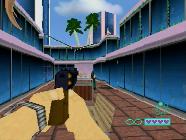 PANDAMONIUM : What inspired you to work on a Sega Saturn game, and ultimately, what inspired Vigilant Paradise? CAMPIONE : Saturn-wise, I had gotten to the end of Super Heavy Duty and was trying to decide what to make next. The Mega Drive / Genesis scene had seen an influx of new games at around 2020, and I think people were probably a bit fatigued. So I wanted to try something else, and something more ambitious. Simultaneously, I was investigating what tools were available, and watching a lot of YouTube videos on fifth-generation consoles. Fifth gen wise, I had grown up with the Nintendo 64 , PlayStation , and arcade games. The Sega Saturn was an enigma in my country, and the like five people who had them were probably either millionaires with rear-projection TVs and Hi-Fi systems twice my height, or kids who won them in a Coco Pops competition. As I learnt more about the Saturn, I realized there was a sentiment that Saturn was really a 2D console, and besides Congo the Movie: The Lost City of Zinj , all the first-person shooters were ports, and they were of the earlier cardboard cutout variety, whilst the PlayStation and Nintendo 64 got Quake 2 and GoldenEye 007 . This felt like a travesty and a scandal, but also an opportunity. I had stumbled across JoEngine in my search for tools, which seemed quite well organized and documented, and would also give me an excuse to buy a Saturn console and experience some of these games that I never got to play. Game-wise, I had grown up by the sea, but had to move inland for work. So I always felt a little separated from my natural environment. Around 2020, I randomly watched a Hulk Hogan film called Thunder in Paradise after the game was featured on James and Mike Mondays . People can say what they want about that film, but watching it brought me back to my ’90s childhood, and life by the sea, and reminded me of the lost genre of escapism that most modern film and television are now devoid of. I was at the time also trying to devise a novel and cost-effective means of playing light-gun games on modern TVs that felt like the real thing and not a Wii game (possibly an alchemist’s pursuit). I had played a lot of Time Crisis 1 and 2 at arcades growing up, and the concept of a cooperative game with two complementary characters that was introduced in Time Crisis 2 was intriguing and something that had not been seen very much at the time. So from all those things I guess an idea was forming of an ’80s/’90s-style tropical system-linked Saturn FPS that would eventually get domesticated into a single-player FPS with two different characters to play. 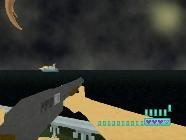 PANDAMONIUM : Did you seek any help from the homebrew community, or was this pretty much a self-sustained effort? I see JoEngine was used. Were any other public tools used too? CAMPIONE : I’m not a member of any homebrew community. As an engineer, my job was already requiring me to spend my days in meetings and collaborating with a lot of stakeholders. As an omnivert, game development was where I could take some time away from people and recharge myself for the next day. JoEngine was well documented and SEGA’s technical documents felt very at home to an engineer. The game started off development in JoEngine, but has ultimately evolved into its own kind of engine in a way with the JoEngine libraries as a kind of middleware for various functions and a tool chain for compilation (JoEngine can be used as an engine proper but I just have not used it in this way). To meet the specific needs of the game, I created bespoke map and model formats; animation, scripting, and event systems; sound management, gameplay systems, etc. I also made some small game-specific tweaks to JoEngine itself. I have used a few different multimedia tools for asset development, notably Blender for 3D and Paint.NET for drawing most of my graphics, or processing photos I’ve taken. PANDAMONIUM : Can you walk me through how the game came together? Did you carefully plan everything out, make changes as you went, etc? CAMPIONE : One of the advantages of working alone (not that there aren’t disadvantages) is that you don’t have a lot of the communication overheads required in team projects. Concept art, storyboarding, design documents, etc. aren’t really required as you don’t need to communicate your ideas to anyone but yourself. I imagine the game out and slowly transfer to the computer. As it manifests on screen, I get a more realistic sense of how things will turn out and I calibrate my imagination. That then iterates and refines. I essentially try to make a game as much as a practical start to finish as a player would experience. First getting the Playnautic logo to fade in on-screen actually solves a lot of basic technical problems. Second, creating menus and a saving system, another set of problems. Then loading a test level, placing a character in it, etc. It then gets refined as you run into problems and learn better ways of solving them. The first four years of the project was spent mostly building the tech and common elements. The final year was where all the levels, cutscene, voice overs, soundtrack, etc. would get fleshed out now that the engine and tools were available. If you look carefully on the stage select screen, you will see little pictures of each stage — these were created back in 2021, so that might give you an idea of how early some of these ideas were kind of planned out and also how they’ve kind of evolved over time. 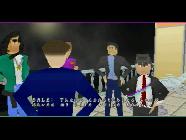 PANDAMONIUM : The cutscenes and voice acting were very well done for a project at this scale. Few Saturn homebrew projects go this hard with presentation. Your homebrew game does things we do not see in other such projects. Tell me about what went into creating the world, the one-liners, the Miami Vice vibes, the stigma against power armor, etc. CAMPIONE : I could probably go on forever on this one, but briefly: From an environmental perspective, much is inspired from living on the seaside and my travels to different places by the sea — places like Kyushu, Sicily, The Gold Coast, and Honolulu. I have never actually been to Florida, but I heard there’s not actually a giant Sonic engraved on a rock face on Daytona speedway. 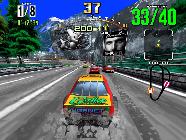 From a story perspective, the ’80s and ’90s saw a lot of crime mysteries focusing on drugs and weapons, because they were the kind of things that were bothering the social psyche at the time. For a more lighthearted and contemporary theme, without revealing much for people that have not played it, the game instead explores themes like AI and other new tech, and how there is a general feeling in society that it’s intruding on the little islands, if you will, of our lives. My sense of humor is probably drawn from growing up watching too much Simpsons and Futurama . The power armor remark is actually one of the many obscure cultural references placed throughout the game — I think it’s more fun for everyone when people figure them out themselves, rather than me list them. The armor itself is a bit of lore for players of my previous game, Super Heavy Duty . 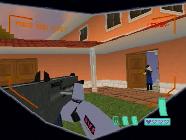 PANDAMONIUM : Did any specific games, movies or shows inspire Vigilant Paradise ? CAMPIONE : The game pays homage to a lot of tropes, archetypes, aesthetics, and cultural icons of the ’80s and ’90s. There is also some obscure 2000s, and even contemporary ones in there. I think people have recognized Miami Vice , I have mentioned Thunder in Paradise , and Time Crisis 2 , but there are many others. It is important to understand, though, the game isn’t exactly trying to be these things per se. If I had made a Miami Vice game I think it would have turned out different. Interestingly for the record, I don’t think I’ve ever yet sat down and watched an episode of Miami Vice . The themes have just been so engraved in the culture that it seems one can know it without knowing it. For something to work it needs to stand on its own two feet without prior context. A successful parody should be entertaining whether or not you know it’s a parody. I have tried to create ultimately fairly lighthearted and unique-in-their-own-way characters with a reasonable amount of depth to them that can be conveyed in the relatively short time the player spends with them. They have been living in my mind in a very abstract sense, and I know them well. If you put Dimare and Crockett in the same situation, you would find they would probably react in different ways. My hope is players will either recognize a bit of themselves in my characters, or the characters will remind them of someone they know or have met, such that they have closer feel for what going in the story. Similarly, hopefully there is also a sense of nostalgia for some players as they recall their own unique experiences with the icons they pay homage to. 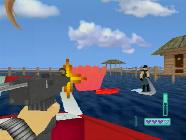 PANDAMONIUM : What was the most challenging aspect of this project? CAMPIONE : Voice overs were quite demanding. Recording lines over and over in a different voice from your natural one for two days takes a toll on your larynx. Finding the right voice for a character or picking the right take can be trying to find the correct shade of white paint at the hardware store. Memory was a challenge. The Saturn has a lot of memory, but it’s divided up between chips and transferring data between them is relatively slow. So a lot of thought and rewrites have gone into where data lives, how much data lives there, and how it’s formatted. VDP2 has a lot of capabilities but they can’t all be used once. So a lot of time and rewrites have gone into picking the right working combinations of capabilities to use in order to create the game’s 2D elements and special effects. Deciding on how music would be played back alongside sound effects and voice overs took a long time and a lot of testing. The Saturn can use MIDI, sound files, and play from CD — they each have their advantages and disadvantages. CD sounds obvious, but as soon as you start CD audio you lose access to the disc, so all the data you need for other things needs to already be loaded in memory. Performance is important for an FPS. A 3D FPS needs to draw a gun that takes up a lot of the screen. On the Saturn, this actually requires a lot of extra draw time, so that lost time needs to be made up elsewhere. A lot of time therefore has gone into optimizations and utilizing both Saturn CPUs simultaneously to share workloads. From a personal standpoint, I ultimately took 2025 off as unpaid sabbatical. I had received the Kojima treatment at a company I was working with and saw years of my work and my colleague’s work destroyed, so I walked away. God is gonna look after you better than any company ever will. This allowed me to work full time on the game and finish it, but my wallet probably was not too happy about it. PANDAMONIUM : How has the response been since you sort of shadow dropped the finished game? CAMPIONE : My response: very sleep deprived, trying to solve some of the problems players have come across since the audience has expanded. Everyone else’s response: there is always the one or two salty sea dogs, but I think the overwhelming response has been very positive. I am very grateful of everyone’s support, and positive feedback, and understanding that I’m not a big AAA studio with a trireme of chained-up devs to row at a problem and solve it overnight (nor would I kind of want to be one). Thank you everyone! Editor’s note: Campione has since created two patches fixing some of the issues with the original release. You can find them on the itch.io page for Vigilant Paradise . PANDAMONIUM : Any plans for future patches or additions? Perhaps another Saturn game? CAMPIONE : My priority is making sure the game is as stable as it can practically be, so I’ll be working on fixing bugs that have been found since the audience has expanded (assuming they are not being introduced by individual models of ODEs themselves). Content-wise, I feel the game is complete and I’ve accomplished what I set out to accomplish in that respect. There may be some tweaks here and there based on player feedback, but I would ask players not to expect there’s going to be suddenly some shameless battle royale mode, RTX-On, or MKU-1 support coming anytime soon. I would note, though, there’s still a secret or two in the game I’ve yet to hear a player discover. God willing this won’t be my last Saturn game. I have the tech now and I already have some ideas in mind, and this may not be the last we see of the characters of Vigilant Paradise . Shortly after the release, though, I started work on a new game. It is mostly paused at the moment to give me time to patch Vigilant Paradise , but when things return to normal, that will be my main focus. I can’t say much about the game yet, and am still unsure how I will reveal it. But if people are curious — it will be a story-focused single-player experience, on a different retro console, slightly longer than Vigilant Paradise, and of a different genre. I’m not sure of the timelines as I’m still looking at what I’m going to do career-wise in 2026. PANDAMONIUM : Your top five Sega Saturn games in no particular order. CAMPIONE : I need to play more games, and now that I have a Saturn, I can. I’ve played through Sega Rally Championship and really enjoyed the road physics and soundtrack. I’ve got a copy of NiGHTS into Dreams I need to play, and in future I’d like to get the Saturn version of Daytona USA and also track down and try out Grandia . A few people have also drawn some comparison between Vigilant Paradise and Die Hard Trilogy , so I’ll maybe track that down and give it a try too. — Again, you can purchase Vigilant Paradise on the itch.io page for the game .
|
|||||||||