The Joy of Playing Grandia, on SEGA Saturn
The Renaissance Period
We are living through a Saturn renaissance. Buckets of titles previously locked away in Japan are seeing new audiences, thanks to the herculean efforts of small but dedicated teams of enthusiast translators, removing the veil of Japanese illiteracy from before our tired eyes. Interestingly, the majority of efforts are being directed at the games with the biggest scripts, and no other genre was as impacted by the language barrier as the text-heavy, story-driven RPG. Over a dozen quality titles are now playable in English. The Saturn is, once again, ascendant…
Ain’t life Grand?
Enter
Grandia
.
What hasn’t been said about
Grandia
? In the run-up to its late 1997 release, the game enjoyed significant worldwide coverage in the gaming press, not least because some positioned it as the anti-FF7 title. Hot on the heels of the remaster of
Lunar: Silver Star Story
and hailing from respected software house Game Arts, featuring state of the art fully 3D environments, a score by notable composer Noriyuki Iwadare, sound effects produced by Skywalker Sound…
Grandia
was indeed shaping up to be one of the premier JRPG experiences of the 5th generation. There was serious talk of bringing the game out West — Working Designs was touted as the favoured house to do the honors, owing to their strong partnership with Game Arts, but the game’s massive script would have meant a late 1998 release by even the speediest conversion standards of the time. By then, the Western Saturn retail market had collapsed, and despite a shrinking but fervently dedicated base of Saturn fans holding on to hope of seeing the title cross the ocean, the game wound up locked away in Japan, forever.
 Sue’s always looking out for Justin. Sue’s always looking out for Justin.
NEVER say Forever
Game Arts subsequently ported
Grandia
to the PlayStation, dropping it in Japan in the summer of 1999. Sony speedily localized the game for Western release later that same year… but we aren’t going to focus too much on the PlayStation version here because, at the time of writing, PlayStation discs don’t boot on your SEGA Saturn. It’s the Saturn game that we are concerned with. For us Saturn stalwarts, we had to wait to the mid-2020s for
an intrepid team led by TrekkiesUnite113 to
transplant the PlayStation’s English script into the Saturn code
. By then, the game was decades old, not to mention re-released and ‘re-mastered’ on modern platforms. So, why translate
Grandia
for the Saturn, when multiple other English options exist?
Because
Grandia
is Best on Saturn.
How do you do
Set in an age of discovery at the dawn of the industrial revolution,
Grandia
initially tells the tale of young Justin — a 14-year-old fearless adolescent who can’t help but dream of adventure. When he isn’t playing at “hero” with his town friends, he’s dreaming of great expeditions to find the lost civilization of Angelou. He is joined by his friend Sue — an 8-year-old girl whose maturity belies her age, and who tries desperately to keep young Justin in line. Justin’s mom Lily runs the local Seagull Restaurant and does her best to raise Justin into a respectable young man… though in her youth, she was a scrappy pirate herself. In her heart, she knows her audacious spark has passed on to her son, and that
Justin will one day take up the adventurer’s mantle and take off on a grand adventure of his own
, so she does her best to prepare him for when the time comes.
She gives Justin a Spirit Stone
— a remnant of the Angelou civilization and a memento of his long-lost father — and in doing so, helps kick off a fantastic voyage that sees young Justin explore, learn, overcome all manner of obstacles, and ultimately, grow and become the hero that he always imagined himself to be.
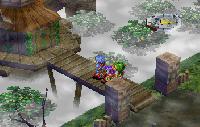 The party’s travels take them to the most interesting locations. The party’s travels take them to the most interesting locations.
During his quest, Justin encounters fascinating characters, both friend and foe. From quiet folk in sleepy villages to rambunctious youngsters eager for their own slice of adventure; from military platoons led by the most beautiful — but hopelessly shallow — lady sergeants to cunning merchants, towering warriors, alluring mermaids and ferocious dragons… Justin encounters them all, and for good or ill, manages to change the course of their lives in ways both subtle and grand.


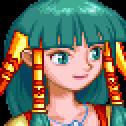
Justin, Sue, and Feena are the first three playable characters in
Grandia
. Young Sue tries to keep Justin in line, while Feena searches for the true meaning of being an adventurer – with Justin slowly moving from admiring her to showing her the way.
The game is clever in pulling the player in for a ride that for a very long while feels very lighthearted and innocent. Even as Justin’s adventure begins in earnest and the player is exposed to antagonists, mysteries, undercurrents and intrigues, Justin can’t help but distill it back to the
very pure essence of boyhood adventure.
Mysterious tower causing problems for a nearby village for years? No problem, Justin will fix it! A dragon from a nearby volcano terrorizing the locals? Justin’s got this. A ghost ship sailing in to harass a passenger steamer? Justin is the answer, in the same way that, as youngsters, we all knew – we knew! – that
WE were the heroes
, and that WE would save the day, armed only with our courage and our grand imaginations. It was our duty, after all. We had it in us to go forth boldly, and change the world (and naturally, all before being called home for dinner).
This point is driven home by Justin’s insatiable desire to uncover the mystery of his Spirit Stone, and the ancient Angelou civilization. After an unfortunate but entirely predictable mishap in the local museum, followed by a mysterious revelation in the nearby Sult Ruins, Justin’s curiosity is ignited, and his drive for real adventure becomes indomitable. Meanwhile, forces are at work that care not for Justin’s explorations, and inevitably, the lad finds himself pitted against the Garlyle Forces and some of its top commanders. Their aims are complex and their operations span the world, and this scope creates a wonderful juxtaposition with Justin’s innocent demeanor and singular focus.
 The amount of architecture being displayed here is stunning, though Grandia makes the Saturn work for it. The amount of architecture being displayed here is stunning, though Grandia makes the Saturn work for it.
On Screen!
The Fifth Generation of consoles marked the rise of 3D graphics, but some genres made the leap easier than others. This shift was a struggle for RPGs, with many excellent titles continuing to employ 2D visuals, albeit in richer color and more sophisticated detail than seen in previous generations. Early attempts at the 3D RPG (
Virtual Hydlide
) highlighted how difficult it was to run this style of game on the hardware of the time without wrecking the framerate or keeping textures from looking like a checkerboard mess. Dungeon crawlers (
Shining the Holy Ark
) were among the first titles to get the 3D right, though the player’s scope of movement was very restricted. Finally, some fantasized that “3D” meant pre-rendered backgrounds and copious FMV clips, with the only real 3D being battle scenes. Ahem!
Grandia
took the traditional overhead RPG view and transformed the landscapes into
fully realized 3D polygonal playfields
that can be rotated and zoomed at will. Character and enemy sprites are then overlain on the 3D world to make the scenes come to life. The addition of the third dimension affords the use of depth in the environments: hills, cliffs, and valleys; minecar rails that ran higher or lower relative to other tracks, and so on. In this way, the player initially feels right at home with a view that looks comfortably familiar, but must quickly learn to constantly rotate the viewpoint to catch enemies in hiding, spy treasures only visible from certain angles, judge heights, and evaluate other geometric details to plot their best course forward.
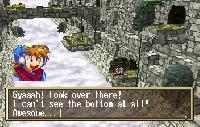 Aside from technical achievements, the art direction is fantastic. Aside from technical achievements, the art direction is fantastic.
Grandia
wastes no time in getting gamers used to this new visual paradigm. One of the game’s first quests sees local frenemy Gantz challenge Justin and Sue to locate the three Legendary Treasures: the fabled helmet (Iron Pot), the storied shield (Pot Lid), and of course, the legendary (Wooden) Sword. The player must traverse all of Parm, climbing down river walkways, checking in enclosed spaces, and chasing down Gantz’s little brother to prove they are up to Gantz’ task — and in the process, get used to the game’s then-new control scheme.
The 3D is very well put together, both technical and artistically. The level of detail is truly phenomenal, from the tiniest objects and details, especially in the ‘in-town’ game sections. Justin is able to interact with some of the innocuous scenery — for example he can knock brooms over, disturb piles of plates, or bump into bells and chimes — just as any real, overly excited 14-year-old might clumsily do as they ran along. Animations, from little weathervanes rotating to laundry fluttering on a clothesline, to puffs of smoke coming up from fires or chimneys, all accentuate the feeling that these are real, living, bustling places. The level of detail, and all of it in 3D, is really special.
The coders at Game Arts made excellent use of the Saturn’s unique hardware when realizing
Grandia
’s locales. Where appropriate, textured infinite planes are used to draw floors, and they not only look good but also dramatically cut down on the usage of polygons in drawing the scene, leaving that much more in the processing budget to spend on other visual details. In later sections, those infinite planes take on a distortion effect to create some very cool-looking water flows — look for them initially in Parm’s pier, and later in places like the snowy Laine Village or the mysterious Castle of Dreams. The water shimmers as the player rotates their view to create a truly stunning effect.
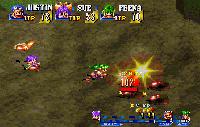 Slimes are never that tough to dispatch in any RPG. Slimes are never that tough to dispatch in any RPG.
The game’s characters and enemies are all represented by sprites that animate quite well and take viewpoints into account as the player rotates the camera. In yet more attention to detail, the sprites darken and then lighten again as the player moves in and out of shadowed areas — an impressive little detail that accentuates the visuals even further.
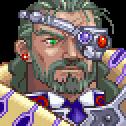
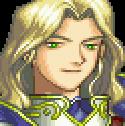
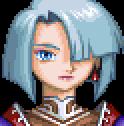
The trio of General Baal, Colonel Mullen, and Leen is introduced in the game’s opening scene, and all three are more than they appear.
The care that Game Arts took in crafting the visuals is commendable and
Grandia
comes off as one of the very best-looking 3D RPGs for the system, but Game Arts was perhaps a mite too ambitious. There are sections of the game where the framerate really chugs. Now, it must be acknowledged that low framerates were a hallmark of many 3D games in the 32-bit era, so some of this is to be expected, but the more detail Grandia is trying to show you, the more you will feel the Saturn huffing and puffing to get the job done. The game’s 3D framerate is not high at the best of times but it is passable, so it’s somewhat of a relief that the areas where it truly takes a dive aren’t too common.
Pump up the Jam!
Game Arts’ attention to detail extends to the sound department. For
Grandia
, Game Arts commissioned Skywalker Sound to handle the game’s sound effects. The result is
positional sound
— effects like running water, crackling fire, etc. will fade in and out as Justin and co. move closer in or further away from the source. Often, if the effect is important, it will also somewhat dampen the volume of the BGM as it plays out. Additionally, the effects will pan left or right depending on the source, and especially as the player rotates the camera. These effects may be subtle, but they are very well implemented and add to the game’s overall polish.
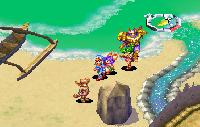 The game is very colorful. The game is very colorful.
The game’s
soundtrack was composed by Noriyuki Iwadare
and is both varied and excellent. Iwadare’s use of instruments appropriate to the on-screen action is uncanny — for example, running around Parm we are treated to an industrial sounding theme, perfect for the town’s motif. The varied use of strings, drums and winds is frankly excellent and lends to the atmosphere, imitating the clang of metal and steel which so permeates the city. Equally impressive is that the music somehow manages to be exciting or somber or poignant without ever sounding overly (excuse the wordplay) grandiose. This keeps the soundtrack in line with the game’s more lighthearted narrative. Of course, where appropriate, the soundtrack does take on that epic quality. The desperate tones that play when the Garlyle forces appear contrast so well with the carefree, upbeat “Off Runs Sue” tune. Mullen’s theme is at once wistful and ambitious, and even the theme from the Sult Ruins dungeon is perfectly mood-setting. Multiple
Grandia
soundtracks have been released since the game’s debut and the soundtrack is universally praised.
 Leen is one of Col. Mullen’s acolytes. Leen is one of Col. Mullen’s acolytes.
How it Plays Out
Grandia
’s gameplay, like so many RPGs before it, is split into two major gameplay slices: exposition-laden town sections and combat-focused dungeons.
Players will spend a fair bit of time in the ‘in-town’ sections of the game. Here, you will wander around, take in the scenery, interact with the NPCs of the area, and almost always, find a quest that must be completed. A quick word about the NPCs — there are quite a number of them in each town, and everyone has something interesting to say… and almost always, each NCP has at least two separate conversation sequences to offer, making for a truly large amount of story to soak in. And
it’s all entirely optional!
It’s completely possible to make one’s way through
Grandia
with only minimal NCP interaction, but the option to enhance the adventure with these extensive NPC interactions is always there, as each character will present a unique view or focused response.
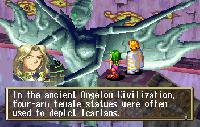 An unlikely pairing. An unlikely pairing.
Predictably, the towns are filled with shops, though
Grandia
keeps things rather simple — there is but one general store which carries weapons, armor, accessories, and even magic all under the same roof. Buy, sell or trade up to the latest gear which gradually increases in the stat boosts it confers to your characters. Additionally, each town typically has one or more important locales, such as mayors’ offices or the chambers of village chiefs.
There is typically an inn or other house where the party can take rest, and at certain points in the game, resting triggers a shared meal scene that sees Justin break bread with his party mates. These meal scenes offer up critical dialogue, which the gamer can extend or keep short at their whim. When the critical conversation has been had, a bedtime icon will appear over Justin’s character sprite, and if the player is quite finished listening to the party chatter, they can select it to end the meal and get some rest. These mealtime conversations serve not only to flesh out what the party must tackle next, but also to offer a glimpse into the inner thoughts of the individual characters as they share their opinions, hopes and fears. Like so much in the game,
Grandia
implements this character exposition in a way that allows the player to decide how much of it to take in.
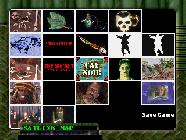 Great use of color. Great use of color.
The visuals in the town sections really stand out.
The Saturn manages to shift not only impressive amounts of polygons for the various structures, but also vivid and complex textures. This technical prowess is coupled with lush and imaginative art direction, resulting in each locale feeling complete and distinct. The dense, humid and green surrounds of Luc Village, nestled deep within the Misty Forest and inhabited by humanoid creatures contrasts sharply with the seaside port town of Dight with its cerulean waves gently rolling in onto its sandy shores. Milda’s hometown village of Laine is covered in snow, and the ancient Zil Padon is an architectural wonder with a central fountain in the middle of the Savanna desert. Game Arts very clearly discarded their standard world building cookie cutters, and their efforts shine through.
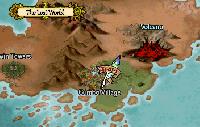 The world map. The feather icon indicates where you will travel next. The world map. The feather icon indicates where you will travel next.
Once a locale has been explored, it will appear as a selectable destination on a gorgeous, hand-drawn high-resolution world map. Exiting an area often brings our party to this world map, and the next destination can be selected.
If the towns serve to heal the party, upgrade equipment, and advance the story, then the dungeons of the game offer treasure hunting, exploration, and of course, combat! Dungeons in
Grandia
range from literal underground labyrinths to above-ground forest mazes, to even large open plains that Justin et al. must traverse. Some of the more noteworthy settings include scaling a giant wall that keeps the world divided into two separate societies, negotiating the bowels of a ghost ship which appears out of nowhere to molest a transcontinental steamer, and even conquering the inside of an unstable volcano that’s inhabited by an ancient dragon.
Here, the player really must use their L and R buttons to shift the 3D landscape around, to find all the nooks of treasure or paths forward. Some areas feature set pieces that Justin and party can activate — for example, knocking over a loose pillar to bridge a gap. These are usually indicated by an exclamation point icon when the party nears the set piece.
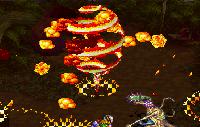 Some of the spells are quite spectacular. Some of the spells are quite spectacular.
All the while, treasure both great and small litters the landscape… but so do enemies! Enemies are visible in the dungeons and so can be avoided to an extent, but if Justin and party come in contact with an enemy, combat ensues.
Grandia
Grinder Alert!
Grind for Experience Points Using Environmental Damage!
Are YOU a
Grandia
grinder?? Some sections of the game will deal damage to Justin and party outside of combat. First noticed in the Dom Ruins, rock faces painted into some of the dungeon walls will cause mild HP damage by springing out and poking the party when the party doesn’t want to be poked! The player can then use heal magic and spam this process to quickly increase Water magic levels. Although definitely a grind, it’s much faster than earning those experience points via combat. A few other areas in the game present similar opportunities — such as the basement in the Castle of Dreams.
A New Kind of Kombat
Grandia
introduced an all-new combat system to the RPG genre, though it could be said to be a variant of other similar RPG battle systems. Essentially, all battle participants have icons that continuously move along a
universal IP Gauge
, until they reach the Command point. Here, the player will enter from a selection of commands which includes attacking, using an item or a spell, guarding, or even retreating. They then wait to reach the very end of the gauge to execute their selected action, and the more experienced the character, the faster that point is reached.
A ton of strategy is introduced here
as during this waiting period between selecting an action and executing it, they are vulnerable to both Cancels and Counterattacks from their opponents. Unlike many contemporary RPGs where the instinct is to simply unleash physical and magical attacks in a turn-based order,
the player can take advantage of these waiting periods
to cancel out incoming enemy attacks and push them back on their IP gauge. The system will take some getting used to, but can be used to devastating effect, especially in the more drawn-out boss battles. It is entirely possible to strategically get in a half-dozen actions by each character and prevent a boss from retaliating during the entire sequence, by carefully timing attacks. This makes combat a lot more involved and exciting.
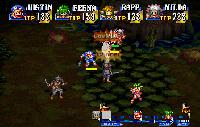 Cancel culture? Counterculture? Grandia’s got it all. Cancel culture? Counterculture? Grandia’s got it all.
There are also advantages to catching an enemy unawares — player characters start much further ahead on their IP Gauge, with the reverse being true if Justin’s party is ambushed.
Players have a range of actions they can take when their IP Gauge is full, from the standard fare of using items, defending, running away, or even inspecting an enemy (is that slug-monster male or female, for example*).
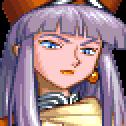
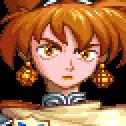
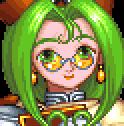
Nana, Saki, and Mio are Mullen’s three she-sergeants. Serving as comedic relief, they are nevertheless quite capable opponents in battle.
By Your Powers Combined… I Am Captain Planet!
Earth. Fire. Wind. Water. These are the elemental forces that move the world, and most characters can master them! Learning magic in
Grandia
first requires that the party finds a
Mana Egg
. These rare items can then be exchanged in a shop for magic for a single character of your choice. That party member then learns the basics of your chosen magic element.
Inside of the four elements, magic spells are further split into levels, from one to three, to indicate their potency. Level 1 spells are your most basic spells and are what a character starts off with should they buy magic with their mana egg. Players that use magic in combat will gain skill points in that particular element, and those skill points are applied to all spells of that element, regardless of spell level — so, use a Level 1 Fire spell, and all levels of your Fire magic gain skill. Spell skill progression is represented by five red stars that fill up like a gauge, turning yellow as they gain experience. Greater experience shortens casting time (which, remember, is a vulnerable time as your spell can be cancelled by an opponent) and at higher levels, allows your character to learn combined element magic spells. All magic spells consume MP making them a limited resource, though a character’s overall MP capacity will grow with experience.
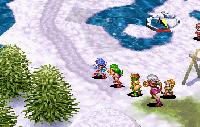 The snowy village of Laine. The water effects are
chef’s kiss
. The snowy village of Laine. The water effects are
chef’s kiss
.
Outside of magic, each character can also execute
special attacks
that are unique to them. These attacks are usually more devastating than standard attacks and sometimes require that the character is using a particular weapon class. These, too, gain skill points represented by five red stars that slowly build up to yellow, though special attacks consume SP (skill points). SP works much the same way as MP.
Grandia Grinder Alert!
Rare Enemies Give High XP
Typically, the game’s monsters do a good job of seeking you out, but there are occasional difficult-to-catch enemies to be found as well. Notice, for instance, the Chameleon enemies in the Virgin Forest. These green creatures are shy and are hard to catch and engage. But persist, and finish them off for a huge load of experience points — well worth a grinding sesh or three.
Experience Required
Grandia
has a complex (for the time) experience points system, which is cleverly segmented into several categories.
 Level up! Level up!
To start, each playable character has a set of basic stats that slowly increase as they gain experience. Hit Points (HP) are your standard measure of health and these increase at level-ups. SP are your skill points, which increase the speed and potency of your special attacks, as well as unlock new special attacks as you accumulate experience. Finally, the same is true of the more traditional magic points (MP), with the difference between SP and MP being that special attacks are individualized whereas magic attacks are more common amongst party members and can be bought in exchange for Mana Eggs.
As they adventure, Justin and company will occasionally find items that slightly
boost a particular stat on a permanent basis.
These items are rare indeed, but as with life, incremental gains tend to compound until the effects are undeniable.
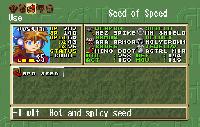 The Seed of Speed grants a permanent stat boost. The Seed of Speed grants a permanent stat boost.
Most traditionally, defeating enemies grants experience points and accumulating the required amount grants characters a level-up, which slightly increases basic stats. Experience gained and gold / treasure collected is displayed on an after-battle screen. It is this type of XP that most contemporary RPGs concerned themselves with.
Grandia
ups the complexity a bit by introducing leveling for magic and skills, and further mixes things up by employing different weapon classes.
Justin and company are each capable of wielding a few different types of weapons, of which there are seven in total, ranging from swords to maces to staffs to bows. Each weapon class has its advantages and disadvantages, be it speed of use (from Command input to Execution on the IP gauge), to range, to overall damage dealt. As party members use their weapons, they gain experience in those weapon types, separately from their character experience.
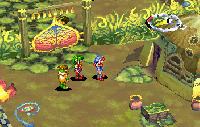 The texture work is awesome throughout. The texture work is awesome throughout.
In total,
Grandia
features basic character experience points which boosts common stats, magic experience which results in spells being cast faster and the learning of higher-level spells for various element types, skill experience for faster execution of special attacks, and weapon experience points which increase how well a character will handle that weapon type. Cleverly, these different experience categories are implemented in such a way as to make it entirely possible for gamers to completely ignore this aspect of the game should they so fancy. Because the system is automated, gamers can pay all of it little heed and still progress and have a great time with the game. Alternately, gamers can dive right into the finer points of the system to make those minor tweaks to get their characters to exactly the state they prefer.
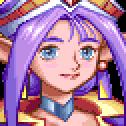

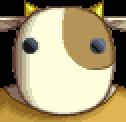
The mysterious Liete awaits at Alent. The enigmatic Puffy accompanies Sue wherever she goes. Lastly, Darlin is one of the many non-human denizens of Grandia.
Go with the Flow
Grandia
allows up to
four playable characters
to form Justin’s party at any one time. As the story progresses, some of the main characters will permanently step away from the adventure, for reasons practical and dramatic alike. One such parting in particular tugs at the heartstrings — it is nothing quite as dramatic as the year’s earlier death of Aeris (Aerith) from that big RPG on Sony’s lesser 32-bit machine, but it somehow feels more relatable, and more impactful. Players ought not be surprised by the need for tissues to manage an unexpected tear or two. And here, too,
Grandia
innovates: a portion of a departing playable character’s magic and weapon experience points are stored in the stashing place, to be retrieved and applied to whatever character you see fit. This strengthens their legacy in your party, as well as provide a practical reason not to neglect building up a character just because they may eventually leave the party. A nice touch.
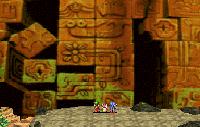 At the foot of the End of the World. At the foot of the End of the World.
Is It Perfect?
Grand as it sounds, the game isn’t without a few small flaws. Story-wise, players will be left wanting to know more about Justin’s father and how he came to be the keeper of his Spirit Stone. He is mentioned often in the early stages of the game, but as Justin’s adventure takes off, that arc never completes. Likewise for General Baal — we eventually learn his motivations, but not so much why he has become who he is today. A really well put together villain is one with whom we can empathise; someone whose circumstance we can understand. Both with Justin’s unnamed father and with Baal, there is a feeling that we are reading a book and that the answers lie just ahead, but despite some teasing,
Grandia
never lets us turn the page.
Technically, the game’s 3D is solid and varied, with plenty of minor details and meticulous textures, especially in the town sections. Blending VDP2-drawn planes with solid geometry and animated sprites means the world of
Grandia
is beautifully rendered, but that comes at the cost of an oft-stuttering framerate. The more of
Grandia
’s world we are allowed to see at once, the more the framerate suffers. Now, these were the formative years of 3D gaming, but at times, that framerate simply chugs, and it’s noticeable to the point of distraction. Thankfully, for most of the game, the framerate sits comfortably in the ‘acceptable’ space, but you won’t get through the game without feeling the Saturn sweat as it works to display all that
Grandia
’s artists wanted you to see.
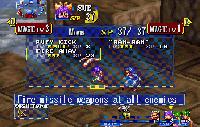 Special Moves. These gain experience as well. Special Moves. These gain experience as well.
Speaking of 3D, the game often requires the shifting of camera angles when exploring. When in long dungeons or any other large space, this can quickly become disorienting, and the player will lose their sense of direction. The game compensates somewhat for this with the addition of the compass, though its implementation is somewhat clumsy as rather than point north, it points to an exit or other objective.
There is also lookout points called Dungeon Scopes
, where the player is given a bird’s eye view of their current location from a default ‘north is up’ viewpoint. This helps orientating, but those lookout points are few and far between and using them tends to break up the game’s flow. Players may well find themselves keeping their camera shifting to a minimum as a result.
Lastly, a technical note:
Grandia
sure gives the Saturn’s laser a workout, and there are some clever pre-loading techniques implemented to keep the game flowing as smoothly as possible. The cost here is that
Grandia
is very sensitive to disc quality. Those that have burnt their English-patched game onto CDs and are playing on real Saturn hardware may well find the game freeze, especially in battle when calling various spells. This is VERY annoying, especially as dungeon save points are sparse, and it is not uncommon to be in the heat of a battle only to have everyone freeze with the reset button being the only escape. This is remedied by using an ODE solution that omits discs entirely, but the game’s sensitivity to the quality of your CD-R burn needs to be called out.
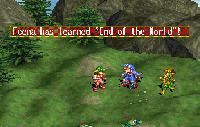 Hell yeah! Feena’s strongest spell. Hell yeah! Feena’s strongest spell.
Final Word
Grandia
is great.
The visuals are gorgeous, the music is appropriately evocative, the combat is frenetically strategic, and the story is well paced. Tough battles and surprise plot twists await intrepid gamers, and sub-plots occasionally weave their way into the adventure, too — especially in sections where we briefly leave Justin. On occasion, players will follow Colonel Mullen with Feena, explore the mysterious past of Mullen’s attaché Leen, or even soak in the comedic antics of the three beautiful Garlyle generals Mio, Nana, and Saki.
Ultimately,
Grandia
a delight to play. A total joy… but one that demands an
intense time commitment
. A player Justin’s age surely has the time, but what about those of us that are well into adulting? Some sections of the game, especially the longer dungeons, have few opportunities to save one’s game. In that sense, the game is a total hardcore, traditional JRPG. It is not easily digested in small play sessions, so playing
Grandia
is committing a huge slice of one’s discretionary time budget.
And yet, perhaps paradoxically, playing
Grandia
has a way of making one feel young again.
Grandia
is grand in the same way we ourselves felt grand as youngsters — that, armed with a stick we’ve just picked up and nothing more than our imagination, our wits, and our indomitable spirit, we could go forth boldly and change the world. That’s the beauty of a main character like Justin — he is not yet jaded; he has not yet borne the
burden of grown-up problems on his shoulders
. In many ways, we were all Justin (or Sue!) at one point, and the game shines a light on that part of us that is now long behind (most of) us. Perhaps the most memorable aspect of
Grandia
is that it allows us, for a moment all too brief, to once again be that young boy or girl full of optimism and energy, and in today’s complex and stressful world, that feels simply wonderful.
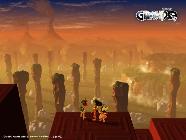 Promotional art that showcases one of the game’s most powerful moments: Justin, Sue, and Feena have climbed the wall at the end of the world, and see, for the first time, the lands on the other side. Promotional art that showcases one of the game’s most powerful moments: Justin, Sue, and Feena have climbed the wall at the end of the world, and see, for the first time, the lands on the other side.
Three Optional Dungeons
Grandia
is generally a well-balanced affair, with experience accumulating at the right rate for players to progress in the game. That said, the world of
Grandia
plays host to three completely optional dungeons meant solely for increasing character abilities and experience — and goes so far as to explicitly point out that these areas are not part of the game’s story and are entirely optional.
The first such dungeon can be found just west of the first section of the Zil Desert. It’s a large, very dark brown multi-leveled maze with the only save point being at the entrance. The enemies are tougher than one would expect at this point in the game, but nothing is impossible for Justin et al. The key here is to find the four Soldier’s Souls, which grants access to the treasures of the dungeon, at the very end, past the boss. The boss is a remix of a previous boss from Feena’s failed wedding to Pakon and packs quite a punch. The main prize here is the excellent Godspeed Knife, which adds a huge ACT boost, to massively speed up the user’s IP gauge.
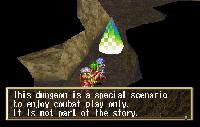 The Soldier’s Graveyard entrance. The Soldier’s Graveyard entrance.
The second optional dungeon is also found to the west but is accessible from the second part of the Zil Desert. This dungeon is very small but has perhaps the most charm. Justin and company are greeted by a mysterious Lady at the castle entrance, begging for help but also warning of a curse on the castle. Once inside, there are several rooms to visit and loot to collect. Really simplistic and set to lure the player to lower their guard, just in time to battle the formidable Lord’s Ghost boss. This guy’s TOUGH, with strong multi-character attacks and cancelling moves. Take him down to claim the awesome Lightning Sword, which gives a 50 ATK boost and, as an elemental sword, has the Zap! spell built in.
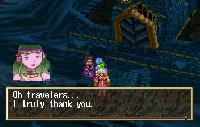 Don’t thank us yet… Don’t thank us yet…
The final optional dungeon is the mother of all dungeons in
Grandia
. Found tucked away in the Savanna Wilderness and accessible via a secret passage, the Tower of Temptation consists of an outside area and 12 (!) floors of punishing combat. Of course, the only save point is at the very start of the outside area, though Justin can activate a couple of shortcuts through the tower as he makes progress, so that backtracking to heal and save is a bit easier. Interestingly, the starting area is surrounded by six Zero Weapons – one of each kind of weapons that grants a 0 ATK value — ideal for training weapons on weaker enemies, as these will do nearly no damage.
Grandia
Grinder Mini-Alert
: many enemies in the Tower drop stat-increasing items, making this an ideal place to pull it all out and go for that growth.
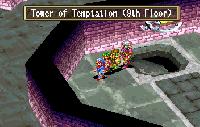 Prepare to spend hours on this dungeon. Prepare to spend hours on this dungeon.
Each floor of the Tower features maze sections, hidden doors, powerful enemies, and of course, switches to hit. Simply by making one’s way through the tower will increase the party’s levels, as there is so much battling to do. It is not uncommon to spend hours in the Tower, so it’s a welcome fact that the Tower is entirely optional. The final three floors are all boss — yes, there are three bosses to fight in a row. No saving, no healing. The final of the three bosses is tough as nails, but the reward is well worth it — NINE amazing items to pick up, including two items from the Grinder’s Gear™ premium collection: the Astral Miracle and the Ethereal Miracle, both accessories that double weapon or magic experience gained. VERY useful, but they better be, considering the pain just endured to complete the Tower of Temptation!
The Universe is Grand…ia
Grandia
went on to
sell bucket-loads in Japan
, especially during release week. It received a Digital Museum DLC-style disc, got a port on the mass-market PlayStation including a PS Greatest Hits re-release, and finally, a PlayStation English localization in 1999. The series continued in 2000 with the excellent
Grandia 2
on Dreamcast, which itself was later poorly ported to Sony’s killer of dreams, the PlayStation 2. That system would also see the less-well received
Grandia 3
, which would spell the end of the main series’ run. The series also saw several spin-off games such as
Grandia Xtreme
and
Grandia Online
. Additionally, the first
Grandia
was recently remade for modern consoles with the release of the
Grandia HD Collection
.
*Note: you cannot inspect monsters’ genders in battle. That was just a joke. Also there is no Grinder’s Gear in Grandia.
I’m Not Crying, You’re Crying!
A beautiful scene.
A bit of a personal story… The above screenshot is my favorite scene in all of Grandia. See, the game does a brilliant job of bringing us back to the days of youthful adventures where nothing at all was impossible, and despite whatever danger beset us, we knew deep down that in the end, we would be all right. But in the most subtle of ways, Grandia also covers personal growth and the passage of time.
At some point, deep into the adventure, 8-year-old Sue gets tired. At first, she temporarily leaves the party whilst recuperating at a local sick house, with everyone hoping (and the player confidently knowing) that she will get better. But… she doesn’t. She puts on a brave face and re-joins the party, going on one final quest. As the gamer, I kept looking for the herb or special item that I could find to cure her, but no such moment ever came. There never was any single wound or ailment that Sue suffered, it’s just that one day, she simply… got tired, and ultimately, had to leave the party. She was a trooper through the entire adventure; completely indispensable she was, but there was a sunset to her time on the grand adventure, and she ended up leaving far too soon for my liking.
In real life, this sometimes happens, too. People in our orbit — strong, vibrant people, whom we believe will be with us forever — sometimes, unexpectedly, undeservedly… get tired, and have to quit the great adventure. Sometimes they are even younger than us, or in better health than us, or benefitting from any number of other factors that make their leaving seem senseless and cruelly unfair. It’s a reminder of the finite nature of life, and that sometimes we are living oh so naively and innocently through what we will later call the best times of our lives.
Sometimes, we get a chance to say our goodbyes before they depart us, and this is something Justin and Feena were able to share with Sue. With tears in her eyes, even as she bade farewell, she wished for Justin to follow his dreams and complete his long quest to find Angelou. It’s this that ties all of these sentiments together, for me. We all get older. We all leave our childhood behind us and begin to lead our adult lives in earnest. Our carefree days of questing and playing our days away, confident that in the end, everything will be all right, are replaced by planning, worrying, pressure, stress, failure, and other harsh realities of life. Here, Sue reminds us of the importance of not forgetting our dreams. We may not have the time or the energy that we did then, but whatever the obstacles, we must always go boldly in the direction of our dreams, hand-in-hand with those who love us, for we, too, will one day exit the adventure. In our final moments, what sweeter satisfaction could there be than to warmly smile at those who walked with us, and to look back on our journey with pride.
|
|
Peter Malek |
| |
A Saturn fan since the beginning, Peter plays Saturn almost exclusively. For Peter, Saturn represents a moment in time where 2D games were at their best, 3D was just rising, and fascinating gaming 'firsts' were commonplace. There are very few Saturn games that Peter cannot find some enjoyment in! | |
|
| |
| |
|