|
|||||||||
ZONE Fills VRChat with a Port of Daytona USAI am familiar with the work of ZONE-SAMA. This artist is a pioneer of 2000’s internet culture, having graced flash animation sites with all time classics such as Reiko: Biker Girl , Ankhazone and Bloo Me . Much of their work is porn. The revered prophet of rule 34 has been called many things over the years. In this moment, we can safely call ZONE a true SEGA fan. The longtime animator, Flash game creator and somewhat safe for work Twitch streamer managed to reverse engineer a functioning “port” of Daytona USA for VRChat. For those not in the know, VRChat is a free program allowing users to interact with others in 3D worlds. You can create your own avatar and get into shenanigans of your choosing with real people. There is a seemingly bottomless library of user-generated worlds you can inhabit. Now one of them is the Advanced course from Daytona USA, as seen in the arcade original for the SEGA Model 2 board. But, like, it’s not just some copy of the track model that you can walk around in. Sure, it absolutely serves that purpose — as an option. This is straight-up playable Daytona USA in VRChat. Before we get into this, I want to coldly admit to you that I have not really played much VRChat. I created an account on the PC version just to try out this custom world. Will I keep playing VR Chat? Absolutely, if more of this happens. 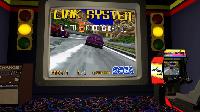 When you first enter the world, you appear in a room with a Daytona USA cabinet in the corner. Its monitor is projected to a large screen on the wall, affixed between two large stoplights flashing to the attract music. Once you click on the arcade cabinet, your screen goes into a recreation of the Daytona USA select screens. A familiar-sounding voice boldly asks you to select a race mode. This essentially lets you pick between choosing to race or run around the track. 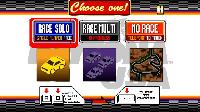 When you pick race, you can either allow CPU opponents to join or do a time attack run. Your avatar is put into the Hornet. On desktop, use the WADS keys to accelerate and steer, while pressing shift for the brakes. The bright tones of Takenobu Mitsuyoshi are heard. Go through checkpoints for time extensions, pull off sick drifts at tight corners… it’s Daytona. 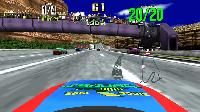 On foot, you can approach a monitor at the pit stop with several options. It includes things like playing videos for visitors to watch, or change the background music to tracks like “ All I Want ” by The Offspring. Maybe you want to hear the Mitsuyoshi sound clips remixed into “ Scatman (Ski-Ba-Bop-Ba-Dop-Bop) .” The players have some options. An achievements menu shows what you have accomplished thus far and even hints at a few upcoming features. Creating this “port” for VRChat was no simple task. So we decided to reach out to ZONE and learn how Hornet came to our VR headsets. It was a yearslong process that involved some collaboration, learning new skills and waiting for VRChat to advance is customization options to just the right level. An interview with ZONEPANDAMONIUM: “I think the biggest question on my mind is how . Is it true that you totally reverse engineered this thing with no source code? Were you at least able to port over any textures or other assets to make life easier? How long did it take?” ZONE: “Yes! The initial project was just going to be an attempt to get the meshes out of the game through whatever methods I could figure out. That proved tricky enough as I was only able to use Ninja Ripper to dump geometry that was visible on screen in SEGA Racing Classic at any given frame. Nothing hidden or occluded would get dumped. This meant I had to slowly drive around the course, forwards and backwards, dumping the geometry data over and over until I had hundreds of separate meshes I then needed to stitch together into the track and cars like a giant jigsaw puzzle. Coupled with that, SEGA Model 2 uses grayscale textures and sets the color of everything using the polygons themselves, and that color data was not retained in and of the meshes I extracted, so I had to manually set the color of each polygon face by looking at the color lookup table that you can get from MAME and attempting each hue until it looked right. You may think coloring something like the cliffs or grass would be as simple as finding the right brown or green, but like with Model 1, SEGA liked to color each mesh with multiple shades of the same color, so I would have to study the meshes in game and see which of three or four different shades they would use for every polygon face. This entire procedure took months to finally get looking perfect! So that was the easy part? Haha! Then to actually make it into a playable game, I did have to just gradually learn C# and eyeball the original arcade version and recreate things as best I could whilst also taking into account that this would have to be fun and playable in VR. A 1:1 port would be awkward for anyone just joining the world so I opted to strike a balance between accuracy and playability, somewhat like how the Saturn port was adjusted to work well on a D-pad. Most VR controllers do not have enough buttons to map to an H-shifter, so I begrudgingly decided to stick with automatic transmission. I do actually have a stack of Daytona boards (well two, actually, the 1994 “release” version and the 1993 location test) so I would reference that whenever I could. I started small, I think just getting the AI cars moving using Unity’s provided Navmesh scripts and then moving onto making my own scripts that would make little things happen, such as the reflections in their windows changing when entering the tunnel. I just built up and up from there, adding things once I was confident enough and taking time to work on other assets such as the fonts or other visual elements when I was hitting a wall with programming.” 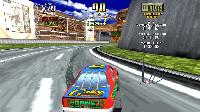 PANDAMONIUM: “Tell me about why you decided to put this together.” ZONE: “The first time I ever played VRChat was in late 2017 when I had gotten an original HTC Vive. I went in there with a friend who also loves SEGA and we searched for some worlds related to games we liked. The first one we entered was the first course from Sonic R. I remember just hearing that cheesy soundtrack and actually being astounded by the scale of the environment when you are actually in it, then running around the track with my friend while singing along to the lyrics and wanting to experience this with every 3D game I’d ever fallen in love with. It was a very memorable and genuinely emotional experience but I knew that this was only the tip of the iceberg for what could be possible here. Daytona USA is my favorite video game ever, by quite a large margin, so the gears in my head were already turning at this point.” PANDAMONIUM: “You could have easily just dumped in a track to walk around and called it good, but you went all out and made this an experience. You start in a room with the arcade cab, get your consciousness transported to a proper Daytona menu, etc. I also love the video wall at the pit stop. Tell me about why you put in so much more than just a track.” ZONE: “In the early days of VRChat, we had an SDK that was extremely limited (SDK2). You could only use Unity’s default assets and scripts, you couldn’t code anything yourself. Pretty much everything clever you could do had to be handled with a trigger system that would usually affect animators. Most worlds reflected that with a few exceptions. Back then I had actually started to recreate the Beginner Course from Daytona USA with that old SDK. A very talented friend of mine called JessiAndroid was quite skilled with SDK2 in terms of pushing it beyond what it was capable of and actually managed to make a drivable car with working speedometer and tacheometer. It was limited to using the default car asset bundled with Unity, it was unwieldly, it was janky and borderline broken, but playing around with it with friends was so much fun! The VRchat devs at the time were talking about the next version of their SDK that would essentially let you just code your own games in their variant of C# and put them into VRChat so we knew that this was definitely the path to head down in the future. I had already finished an attempt at Ridge Racer in SDK2 (which still works in VRChat in Desktop mode) but I knew that if I wanted to tackle my true love, I would give it my absolute all and wait for SDK3. Once that finally launched, probably over a year later, Jessi was too busy with other things to help out, so I figured that if I ever wanted this to really happen, I would have to do it myself! I think having no obligations with time or expectations from others allowed me to just kind of keep going with it until it truly was as big and beautiful as I could possibly make it! And thankfully, after all the time it took to complete the project (around four years), Jessi was less busy and actually made the little arcade room that you start the world in! The textures on the Daytona cabinet were repurposed from a custom mini MAME cabinet that I designed some years prior.” 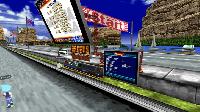 PANDAMONIUM: “Any plans for future additions? New tracks, gameplay modes, maybe adding some Nap on Monday to the song list?” ZONE: “I do have a little roadmap for future additions, yes! People have asked a lot about new tracks, particularly the Beginner Course, but I think if I were to do that, they would be separate worlds as cramming them all into one would likely hurt performance somewhat, as well as making it too large to run on Quest / Mobile anymore. Speaking of size, the one thing that takes up 90% of the data in the world is just the music! So as much as I would love to add some Nap On Monday , it would balloon the world very quickly! I will say that I am planning to add an option to add custom music using a YouTube URL instead in the next major patch. So you’ll be able to race to Crazy Frog or whatever else you like! I have also considered making a multiplayer Horse/Uma mode where everyone rides a different colored horse.” PANDAMONIUM: “You have this neat internet celebrity status for your large catalogue of previous works, animations, Twitch streams, fap fuel, etc. I saw someone write a comment saying this Daytona USA world is like the local drug dealer opening up the best fine dining restaurant in town. What is it like to have such a wide range of creative output?” ZONE: “I am fortunate enough to have been online long enough, created enough content and developed a large enough following that I am pretty much able to just make what I like and somehow able to survive financially. I think having such a diverse range of material may be confusing to anyone on the outside, or at the worst of times, frustrating to them if they are only interested in any one of those things and consider the others to be a waste of time. But in general, I just like to create things that make me happy and in turn also make others happy! Whether it is 2D animation (hentai or otherwise), making video games, composing music, entertaining through streaming or dancing around in VR, I just enjoy being creative and sharing it with anyone who cares to partake. Sometimes the pendulum may swing in one direction more than others, but it does not mean that I have quit doing X to go and do Y.” 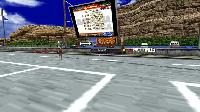 PANDAMONIUM: “What got you into Sega, and how did you become a Saturn fan?” ZONE: “SEGA were always a mark of quality to me from the early days of seeing their arcade cabinets in the ’80s. I never owned the original NES, my first home computer was the Commodore 64 from which I went to a SEGA Genesis when it launched in ’89. The string of hits that SEGA kept putting out for that system really got me hooked on their brand. And while their 2D offerings were impressive enough, it wasn’t until I saw the original standalone Daytona playing on that giant 50” rear projection screen in an arcade near me back in ’93 (it was a single player location test cabinet and I’m not sure how they got it!) that I was truly floored by what I was witnessing. It’s hard to imagine when you look at it now. But going from games like Street Fighter II and Outrun, which were impressive enough, to a full 3D, texture mapped environment, perspective correct with texture filtering running at 60fps was and still is the most staggering jump in video game technology that I have ever seen. It almost seemed inconceivable, like looking into the future. I remember just staring at it, watching the rolling demos, seeing people playing, hearing the booming sound effects and bombastic soundtrack, almost afraid to go near it like, “Am I allowed to even touch this?” It was the kind of thing you would normally expect to see as some kind of intangible prototype in a museum or at NASA with railings around it. But here it was, for anyone with change in their pockets to enjoy. I think this was the moment that I just fell deeply in love with SEGA and knew that I would follow them to the ends of the earth. While I was already loving Sonic and many other Genesis titles at home, this really showed me that SEGA were not just screwing around when it came to video games, they meant business. Needless to say, I wasn’t going to be satisfied with only being able to play this game when I was at an arcade, I needed it at home. So I was definitely going to own whatever system SEGA put this on. Hence, me picking up a Saturn with a copy of Daytona on launch day!” PANDAMONIUM: “Top five favorite Saturn games in no particular order?” ZONE: “ NiGHTS Into Dreams , SEGA Rally Championship , Virtua Cop , Panzer Dragoon Saga and while the port was severely lacking, Daytona USA ! And if I might give some honorable mentions: Burning Rangers , Fighters Megamix , Guardian Heroes .” PANDAMONIUM: “What are you working on nowadays and how has life been treating you?” ZONE: “I am currently working on a sequel to Ankhazone as well as completely redesigning my website (NSFW) . It still currently uses the basic HTML that I learned in the 90s! I’m patching and tweaking Daytona in my spare time as well as streaming regularly on Twitch . I have a bunch of mini-projects on the go at all times, so just in general keeping busy, working hard and playing hard! Life always has its ups and downs but in general, things have been good! I just look forward to always being able to create new, fun things.”
|
|||||||||